Unlike the storyline of Red Alert 2, the narrative of Bellum Æternum closely aligns with real historical events and does not incorporate any plot elements from Red Alert 2. The background story of Bellum Æternum not only drives the progression of campaign missions but also influences the weapons and equipment available to players. If you are a fan of Cold War military history, Bellum Æternum is a Red Alert mod tailor-made for you.
World War II
During World War II, the conflict spurred remarkable technological advancements for both the Axis and Allied powers, with each side achieving astonishing scientific breakthroughs.
However, the brutal war and numerous humanitarian disasters left a lasting scar on humanity worldwide.
With Japan's surrender in 1945, World War II came to an end. At this point, the Cold War dynamic between the United States and the Soviet Union had already begun to take shape.
An Iron Curtain has descended across the continent, from Stettin in the Baltic to Trieste in the Adriatic.
—Winston Churchill
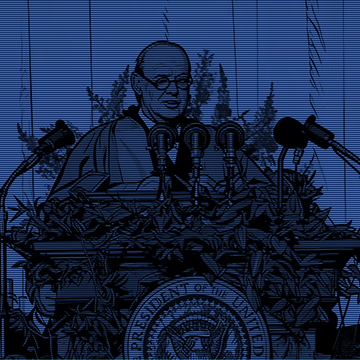
Korean War
The first hot war of the Cold War erupted in Korea. The United States assembled 17 nations to form the United Nations Command (UNC) and initiated the Korean War. In response, the Soviet Union strengthened its military preparations while encouraging China to join the conflict.

In 1950, China sent the People's Volunteer Army to fight in Korea. After five major campaigns, the UNC was pushed south of the 38th parallel.
The war continued until 1953, with the battlefield in a stalemate. The UNC was unable to defeat the significantly less-equipped People's Volunteer Army.
The United States initially aimed to establish a containment line stretching from Anchorage, Alaska, to Canberra, New South Wales, to block Soviet access to warm-water ports. However, the situation in Korea prevented the U.S. from stopping Soviet naval deployments in the Yellow Sea. Consequently, the U.S. urgently sought to annex the Korean Peninsula entirely and establish large-scale military fortifications to counter the Soviet Union from the Far East.
Formation of the Allied
At this juncture, a secret meeting was held in Washington. The meeting resulted in the decision to establish a new military organization centered around North America, Europe, and Australia, codenamed the Allied.
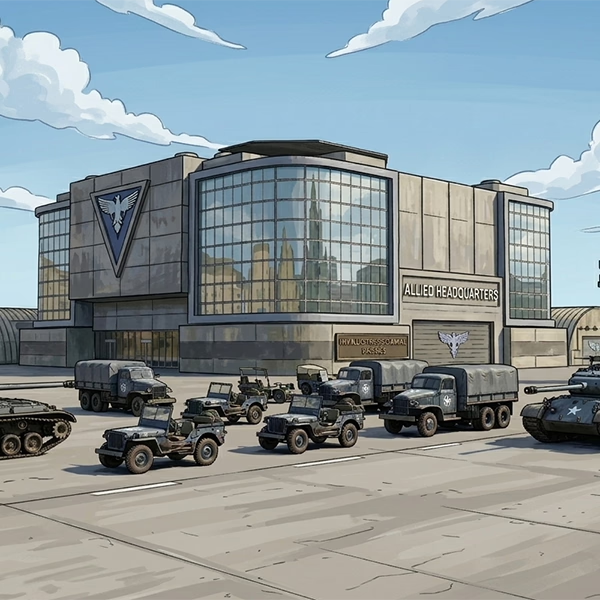
Unlike the UNC, the Allied were a military organization entirely led by the United States. The formation of the Allied resolved several cumbersome issues within the UNC:
- Force Composition: The Allied consisted of elite units drawn from Western Europe, North America, and Australia, with a unified command system issuing orders from headquarters in Brussels.
- Military Equipment: All Allied equipment was standardized and supplied by the United States. Allied forces began transitioning to new equipment, such as the M54A2 Grizzly Tank.
- New Technology: With the establishment of a new command system, the Allied adopted a technology called SCP (Standardized Construction Protocol), which led to the development of the MCV (Mobile Construction Vehicle).
The formation of the Allied revitalized the disorganized UNC. In 1954, they rejected a Soviet proposal for peace talks and returned to the Korean battlefield. Subsequently, the Korean War rapidly tilted in favor of the Allied, threatening the borders of the Soviet Union and China.
European Force Vacuum
Due to the formation of the Allied, large numbers of elite European troops and equipment were redeployed to the Korean Peninsula. The forces remaining in Europe, though integrated into the Allied system, were significantly outdated:
- Command System: Composed of second- or third-tier units from Western European countries, the command system was not fully unified, largely due to France's lack of cooperation.
- Military Equipment: With the U.S. strategic focus shifting to East Asia, European Allied forces were left with outdated equipment, such as Patton and Sherman tanks, with only a small number of MCVs deployed in London.
- Frontline Supplies: Due to the lingering effects of World War II, Western European industrial capacity was still recovering, resulting in limited supplies for Allied forces in Europe.
- Political Instability: While the Allied standardized military equipment, the fact that all weapons were American-made caused significant discontent among Western European governments.
Meanwhile, the Soviet Union, having avoided direct involvement in the Korean War, learned of the Allied force vacuum in Europe through KGB intelligence and devised a new plan.
Berlin Riot
In 1956, a riot broke out in a tavern in West Berlin, escalating into unprecedented chaos. That evening, Soviet forces in East Berlin intervened under the pretext of suppressing the riot and blockaded West Berlin. Recognizing the gravity of the situation, Allied leadership met with Soviet representatives in West Berlin for negotiations. The Allied demanded the withdrawal of Soviet forces, while the Soviets countered that they would leave West Berlin if the Allied withdrew from Korea. The talks quickly collapsed, and as the Allied representatives left West Berlin, Soviet forces began executing their military plan.
New Soviet Plan
Following Joseph Stalin's death in 1953, the Soviet leadership underwent intense political struggles, culminating in Nikita Khrushchev's rise to power with the support of the Soviet military.
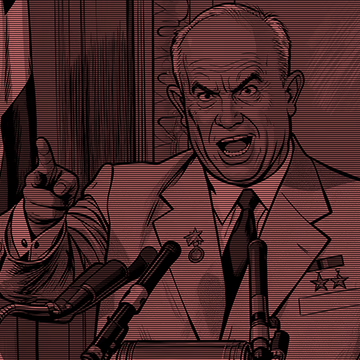
Aware of his numerous political rivals, Khrushchev sought to establish authority within the socialist bloc through bold foreign policy actions. He devised an ambitious plan:
- Implement military reforms, equipping armored divisions with T-56 Rhino main battle tanks and advancing research into missiles and tesla weapons.
- Consolidate intelligence networks by establishing the KGB to monitor Allied movements closely.
- Strengthen diplomatic ties with China, providing military aid and supporting hundreds of heavy industrial projects to counter the Allied in Korea.
- Increase involvement in the Korean War by expanding the MiG corridor and supplying additional resources.
- Execute Operation Pravda (Truth).
These plans were set in motion in 1954, with the ultimate goal of paving the way for Operation Pravda, a massive military campaign divided into four phases:
- Expand 20 additional armored divisions and deploy them to East Germany, Czechoslovakia, and Hungary.
- Control East Berlin to lure Allied leadership to Brussels.
- Invade West Germany, leveraging its advanced highway network for a blitzkrieg into Belgium to eliminate Allied leadership gathered in Brussels.
- Advance south into France, coordinating with French communists to force France's surrender.
Khrushchev believed this strategy would force the U.S.- and U.K.-led Allied to abandon their plan to contain Eurasia from the east, shifting their strategic focus to Europe and ultimately exhausting their resources there. The Soviet military envisioned occupying the Mediterranean region, encircling the Americas from Europe and Asia.
Operation Pravda
In 1956, the Soviet Union mobilized its entire armored force, with thousands of Rhino tanks invading major West German cities overnight. Most Allied forces were disarmed under cover of darkness, and by dawn, Soviet armored divisions had reached the Belgian border. Allied leadership, having held an emergency meeting at their Brussels headquarters, scrambled to deploy remaining forces. However, the Soviet Rhino tanks faced only outdated Patton or even older Sherman tanks in Belgium, which were unable to penetrate the Rhino's frontal armor. The Soviets quickly advanced to Brussels.

Due to the European force vacuum, Allied defenses in Brussels were sparse, and they were tasked with evacuating leadership before the Soviet arrival. Only a single armored company remained to defend Brussels. The Allied destroyed highway bridges and dispersed their tanks throughout the city, preparing for urban combat. However, the KGB had already informed Soviet command of Brussels' defenses, and the Soviets sent only one armored company, supported by paratroopers and artillery, to seize Allied headquarters while the main force advanced south to attack France. The following day, Paris fell to the Soviets.
For the Allied forces in Europe, their frontlines continued to retreat, with many troops captured. Allied units withdrawing from Brussels and Paris regrouped in Lille, preparing to make a last stand. However, a critical intelligence report—“Allied headquarters destroyed, Austria fallen, Italy declared neutrality and allowed Soviet passage”—proved to be the final blow. Soviet forces entered southern France from Italy, collapsing all Allied defenses in France. British Allied representatives who escaped Brussels convened a meeting in London, quickly establishing a temporary Allied headquarters. Under London's coordination, thousands of Seahorse landing craft sailed to Dunkirk, and Allied forces in Lille withdrew, resisting while retreating.
Bellum Æternum
In the campaign missions of Bellum Æternum, players will take on the roles of Allied and Soviet commanders, using strategic vision and leadership to determine the outcome of this war.
Can the Allied stage a desperate comeback? Will the Soviets plant the red flag across the world? Stay tuned for the all-new campaign missions of Bellum Æternum!
Welcome back, Commander.